Nuffnang Add

Showing posts with label Concept. Show all posts

Thursday, March 24, 2016

Honda CR-V 2012


There’s a new Honda CR-V on the way and the Japanese firm has given an early glimpse of how the fresh 4x4 will look with this concept.


Set to debut at the Orange County International Auto Show in California during September, the CR-V Concept gets narrower headlights than the outgoing car as well as a more pronounced three-bar chrome grill.


As it stands, there are no pictures of the rear but this shot appears to show a stretched body and taller back section which could accommodate a third row of seats to boost the CR-V from a five-seater to a seven-seater. 


Don’t expect to see too many changes from this concept when the CR-V reaches production, but the tinted windows and large alloys are likely to be toned down slightly.


Honda is keeping quiet on what powers the Concept, but any production car will boast improved efficiency and lower emissions over the 148bhp 2.0-litre petrol and 2.2-litre diesel engines currently available in the range.

2012 Mercedes A-Class leaked!


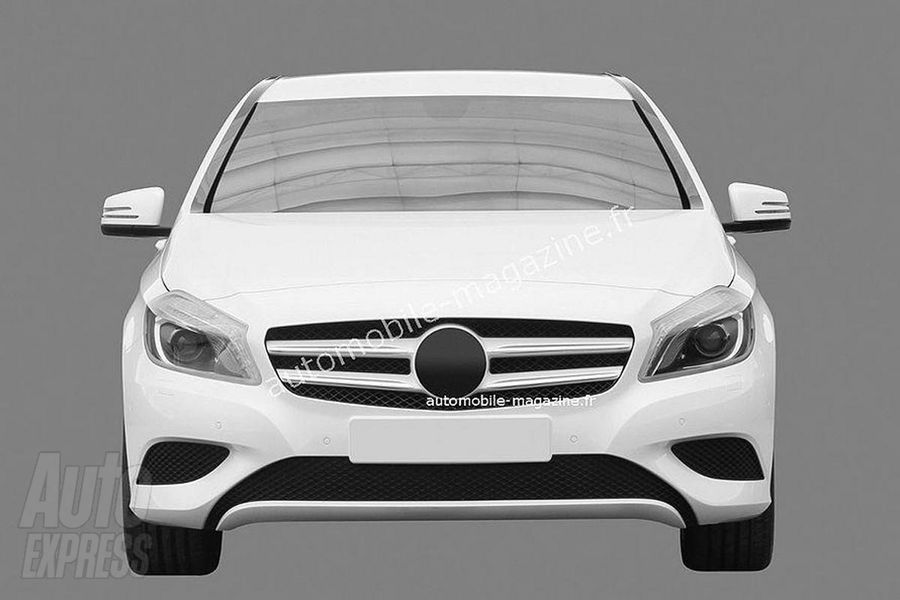
Yet again, the European Patent office has sprung a leak. Detailed drawings of the production-ready Mercedes A-Class have surfaced on the web, via French website automobile-magazine.fr. And they show every curve and crease of the premium hatch.


This comes only three weeks after the Concept A, a radically-styled concept that previewed the production A-Class, made its global debut simultaneously at the Shanghai and New York Motor Shows. And elements of the Concept A's styling can be clearly seen in the showroom-ready model.


While the concept was in sleek three-door form, the drawings depict a more practical five-door hatch, suggesting that both bodystyles will be offered. Predictably, the show car's psychedelic front grille and lower air intake have been substituted for a less-dramatic upright two-bar opening with a trio of air intakes underneath. The bulkier headlights appear to feature LED 'eyebrows'.


In profile, a truncated rear, long bonnet and roof spoiler give it a dynamic stance and a look reminiscent of its biggest rival, the BMW 1-Series - a model that's due to be replaced later this year. The inticate surfacing on the side of the car is neatly reinterpreted for production, while tt the rear the light clusters wrap around the corners of the car, but are deeper than on the concept and omit the horizontal linking bar.


Under the skin, the A-Class will feature an all-new front-wheel drive platform with McPherson struts at the front and a multi-link rear axle, while power will come from the latest C-Class engines with a line-up of four-cylinder petrol and diesel units. There will also be a new 2.0-litre turbocharged and direct-injection petrol motor, which the Concept A previewed in 204bhp hot hatch form, hooked up to a dual-clutch gearbox.

Peugeot SXC


Peugeot is thinking big, and here is the proof! The French firm has unveiled its brand new large crossover concept at this year's Shanghai Motor Show, the SXC.


Designed at Peugeot's China Tech Centre in Shanghai, the show car measures 4.87m long, 1.61m high and 2.04m wide - that's a few millimetres shorter, but wider and lower than BMW's X6 - the model the coupe-like SXC is gunning for.


The brave exterior design sticks closely to the themes introduced on Peugeot's most recent concept cars, including the SR1 Roadster, BB1 city car and smaller HR1 crossover. It features the same floating grille, wafer thin headlights and sculpted bodywork as those other show cars, as well as the boomerang rear lights.


Despite its sloping roofline and high waist, the SXC features a spacious cabin, thanks to its generous dimensions, and it's accessed via Rolls-Royce Phantom-style reverse-hinged doors. A two-part panoramic roof floods the cabin with light.


As its looks suggest, the SXC benefits from four-wheel-drive traction, but the powertrain incorporates Peugeot's HYbrid4 technology. A 218bhp 1.6-litre THP petrol engine drives the front wheels, while a 95bhp electric motor sends power to the back. That gives a maximum output of 313bhp with a combined fuel consumption of 48.7mpg and CO2 emissions of 143g/km.

Toyota FT-86


The return of the Toyota sports car moved a step closer when the firm revealed the FT-86 II concept, our first look at the car that will become a production reality in 2012.


The rear-wheel drive coupe will look very similar to this menacing black machine, with the aiming of attracting back customers who remember sports cars like the Supra, Celica and MR2.

Powered by a two-litre boxer engine developed with Subaru – which also showed its own version of the FT-86 – the car will be seen in production form at the Tokyo show this year, with sales starting next year.

Toyota hasn’t released a price, but the firm is known to be anxious not to alienate its mainstream customers.

BMW roadster concept revealed


It's open season for concept cars! This is BMW's Geneva show car - a two-seater roadster called the Vision ConnectedDrive. Its purpose is to present the latest evolution of design director Adrian van Hooydonk's layered styling language, and showcase a raft of cutting-edge technology that could debut on the forthcoming EfficientDynamics supercar and MegaCity electric city car.


The overall dimensions are typical for a BMW Roadster with a stretched bonnet, long wheelbase and seats set well back towards the rear axle, but the front and rear treatment and body surfacing is entirely new. The round headlights sit more upright than usual, while the L-shaped rear lights preview a more sculptured look that will appear on production model in the near future.


The surface treatment will be recogniseable from the Vision EfficientDynamics concept, which used a similar 'layering' principle. According to BMW: "The term “layering” describes a new approach to the BMW Group’s design language, redefining the way surfaces, interfaces and materials have been treated in the past."


In a nod to the past, the ConnectedDrive uses electric sliding doors inspired by those seen on the Z1 roadster built between 1989 and 1991. The double-layer doors open by the outer shell sliding forward into the bodywork and the rear shell retracting backwards, allowing the passengers to enter over a wide sill.


But it's technology that's key with this car. Numerous sensors, mounted in the front and rear light clusters, monitor the environment in front, behind and on both sides of the vehicle. These are capable of recognising people and other vehicles and pass relevant information to the driver.


Multi-coloured fibre-optic strands running around the cabin represnt the flow of information, and are activated when a certain funtion is switched on - one of the reasons why a roadster bodyshape was chosen, to best show off the cabin.


A new head-up display aims to represent information in an entirely new way. It projects a 3-D picture onto the windscreen with layers on information, one behind the other - offering the most amount of data to the driver in the most efficient way possible. For example the most important function will sit in the foreground, with other less-relevant stats ghosted into the background.

Peugeot Moville Eye Drop Concept


MoVille is a compact single passenger vehicle with artificial intelligence and zero-emission drive train. Once you look at this vehicle, you will feel that you have entered into Robot world. There are three magnetic wheels which are rotated with the help of electro magnets. For saving space in urban areas, MoVille can tilt up and down. It features wireless road network in order to connect to other vehicles and road network. With this feature, it can judge where it is located on the road and where other vehicles are. MoVille is also fully equipped with immediacy sensors, cameras, and GPS. Small size and Omni-directional wheels enable anyone to park it easily.


MoVille consists of a single passenger capsule over an electric drive train. Three magnetic ball wheels are rotated without frictionless through electromagnets. Passenger capsule is shaped in an aerodynamic teardrop shape for maximum efficiency. It also tilts up and down for saving space in urban streets and become more aerodynamic on highways.


MoVille’s compact size takes up less space in dense urban cities. Because it has a sliding window door, it is easy to get in and out of in tight spaces. The passenger capsule tilts vertically to save space on the road and pivots for getting in and out.
MoVille features wireless road networking that allows for it to communicate with other cars and the road network. It is aware of where it is on the road and where other cars are. This allows for reduced traffic jams since cars can accelerate/decelerate synchronously. It also reduces the possibility of accidents.
MoVille’s small size and omni-directional wheels means it is easy to park. Equipped with proximity sensors, cameras, and GPS, MoVille can drive and park automatically.
MoVille features an organic led display on the façade that allows passengers to communicate and personalize their own cars. Because MoVille doesn’t need any headlamps, the OLED “eyes” are used for displaying vehicle status (running/charging/turn signal/etc).


MoVille has an artificial intelligence which allows it to act more like a robot than a car. MoVille recognizes its owner and opens its doors when you approach it. MoVille can drive itself allowing the passenger to save time.
Although MoVille can drive itself, it can be manually controlled with your digital devices like cellphones and portable game consoles. MoVille communicates with these devices which allow the car to be driven wirelessly. The dashboard can be retracted on demand.


MoVille has an electric drive train that uses electromagnets to rotate the ball wheels. Because there is no mechanical transmission and internal combustion engine, it is more efficient, and more reliable. MoVille’s compact body is built out of unpainted biodegradable plastic.
MoVille’s unique form factor allows it to integrate a second sliding door with integrated photovoltaic solar cells which can recharge the car’s batteries.

Wednesday, March 23, 2016

Toyota Prius C concept

Compact hybrid concept takes Prius family tally to four, and previews production model for 2012.


The Prius is growing down as well as up! Toyota has sprung a surprise in Detroit, unveiling an all-new smaller member of the Prius family called the Prius C concept.

Joining the standard car, the plug-in Prius and the new Prius V on the show stand, the C is aimed at a much younger customer base, and while Toyota say this is strictly a concept, it conceded that a production version inspired by this show car would go on sale in 2012.


Designed at Toyota's European design studios, ED2 located in Sophia Antipolis, South-East of France, the C will be the most affordable and also the most efficient member of the Prius family when it reaches production - thanks largely to its low weight.

With four doors and four useable seats, the most obvious rival is the Honda Insight which has always been cheaper and smaller than its arch rival, the Prius. However, with its edgy styling and youthful appeal it could double up as an alternative to the Honda CRZ coupe, too.

MINI Scooter concept


Meet the two-wheeled future of MINI! Following the success of the plug-in electric scooter concept that premiered at the Paris Motor Show, MINI is ready to green-light a range of two-wheelers.


Just like the MINI E Scooter Concept, the bikes will feature scaled down versions of all the classic MINI design cues, including the large iconic speedometer, oval wing mirrors and squared off rear lights. The use of chrome and other material is also designed to make the scooters instantly recognisable as a part of the MINI family.


The grey and luminous green colour scheme of the concept was borrowed from the MINI E electric car, and so is the drivetrain: a single electric motor is integrated into the rear wheel, and power comes from a compact lithium-ion battery stored under the seat. The battery can be charged from any standard A/C power outlet, via a retractable cable at the back of the scooter.

MINI used the Paris Motor Show concept to gauge public reaction to the scooter, and is keen to make the production model electric. We should see a version towards the end of 2011, with the finished model likely to be used during the London 2012 Olympics, which BMW is an official car supplier for.

2012 Subaru Impreza revealed!


The next Impreza is getting a dramatic new look. This is the first official picture of Subaru’s Impreza Design Concept, which debuted at the LA Motor Show. 


The Japanese firm has already backtracked over its decision in 2007 to reinvent the Impreza as a hatch – it introduced the WRX STi saloon last month – and this concept reinforces its move.

Marking out the newcomer is a completely new design language, called Confidence in Motion – and it’s a big departure from previous versions, as our Impreza timeline (below) shows. The aggressive new front end – with hawk-eye headlights, 3D grille and wing-like foglamps – previews a fresh family face that could grace the new Subaru coupé.


The Impreza has a low and wide stance, while bosses say the prominent wheelarches put the emphasis on the car’s famous symmetrical all-wheel-drive system. The rims also get carbon fins to help cool the brakes. 


The interior is as attractive and different as the exterior. 


Double stitching and dark blue piping contrast with platinum leather, while a large central touchscreen combines functions for the navigation, audio and vehicle information systems. 


Under the bonnet, the Impreza show car features a 2.0-litre boxer engine hooked up to a CVT box. A final production version isn’t due to appear until 2012.

Mercedes wows with Biome concept


Meet Mercedes’ new green machine. This is the Biome concept, the German firm's entry to the LA Show’s annual design challenge competition, and Auto Express was there live for the unveil at Mercedes advanced design studio in LA.


The Biome is a pure flight of fantasy and isn’t intended to influence any future model. However, the technology used to create the car is intriguing as it’s straight from the pages of a sci-fi novel.


The Biome is built to the 2010 Los Angeles Design Challenge rules, which are to build a safe and comfortable two-plus-two compact car that weighs no more than 1000lb (454kg). However, it tips the scales at just 394kg as its chassis, body and fuel storage is made from a material called BioFibre.


BioFibre is an organic material which can be genetically manipulated. Like something from The Matrix, a Mercedes three-pointed star, which is impregnated with DNA which contains the spec of the car, is planted in a Mercedes nursery in a nutrient-rich substance called Bionectar, which is harvested from trees.


The Biome’s body then grows from the seed, taking just one day to mature into a finished body. The mature material is called BioFibre, which Mercedes’ claims is lighter than metal or synthetic composites, but stronger than steel.


The Biome measures 4020mm-long and 2500mm-wide and features a four-seat cockpit laid out in a diamond shape, with the driver up front, flanked by two passengers in the middle further back and a single seat in the rear.

Citroen Metropolis Concept


Designed from start to finish in Citroen’s Shanghai studio, the 5.3-metre long car reinforces just how important China is to the firm. Sales were up 57 per cent in 2009, and the market is now its second biggest after France.


The Metropolis takes a more sober approach than many of Citroen’s recent concepts, but keeps the same show car design language of the DS3 hatch. The familiar blade detail ahead of the front wheelarches runs elegantly into a thin metal strip separating the headlights.


Down the flanks, a prominent crease creates a shoulder effect that tapers inwards and down to the boot, with its active spoiler. However, the heavy surfaces are broken up to dramatic effect around the nose thanks to details such as the plunging grille, the badge cutting into the bonnet and the ‘floating’ undertray that brings to mind the aggressive 2008 ‘GT by Citroen’ concept.


No pictures of the cabin have been released yet, but Citroen claims that the styling will be ‘partly inspired by Chinese musical instruments’. The Metropolis’ hybrid drivetrain incorporates 2.0-litre V6 petrol power mated to an electric motor to deliver 460bhp, while emitting 70g/km of CO2.

GM EV-N Concept


General Motors has unveiled its vision of the future. Called the EV-N Concept, the two-seater fully electric concept has been developed by GM alongside its Chinese business partner SAIC, and made its public debut today in Shanghai.

The ‘Electric Networked-Vehicle’ is designed as an ideal solution for urban mobility and seats two passenger side-by-side in an upright position. Propulsion comes from two electric motors, one in each wheel, producing 440Nm of torque for brisk acceleration, although the top speed is just 25mph and the maximum range 25 miles.

GM has worked closely with Segway to give the EV-N the ability to self-stabilise on two wheels, much like the Segway scooter. This means the vehicle can turn within its own footprint, while there’s space for two passengers plus luggage in a vehicle that takes up roughly a third of the road space of a conventional vehicle.

By combining GPS with vehicle-to-vehicle communications and distance-sensing technologies, the EV-N can be driven manually or entirely completely autonomously – leaving you free to get on with work or read the paper while it shuttles you to your destination. It can also communicate with other EV-Ns to get real time traffic information and ensure you’re always on the fastest route.

Using vehicle-based sensor and camera systems, EV-N can “sense” what’s around it, allowing the vehicle to react quickly to obstacles or changes in driving conditions. GM claims this makes it virtually uncrashable – allowing the bodywork to be built from lightweight carbon-fibre and plastic and keeping the weight below 500kg.

Three different versions of the EV-N were unveiled in Shaghai although they share almost identical dimensions – the blue Xiao (Laugh) created at the GM studio in Australia, the red Jiao (Pride) penned at GM’s European studio in Germany and the grey Miao (Magic) born out of the GM Advanced Design Studio in California.
Related Posts Plugin for WordPress, Blogger...