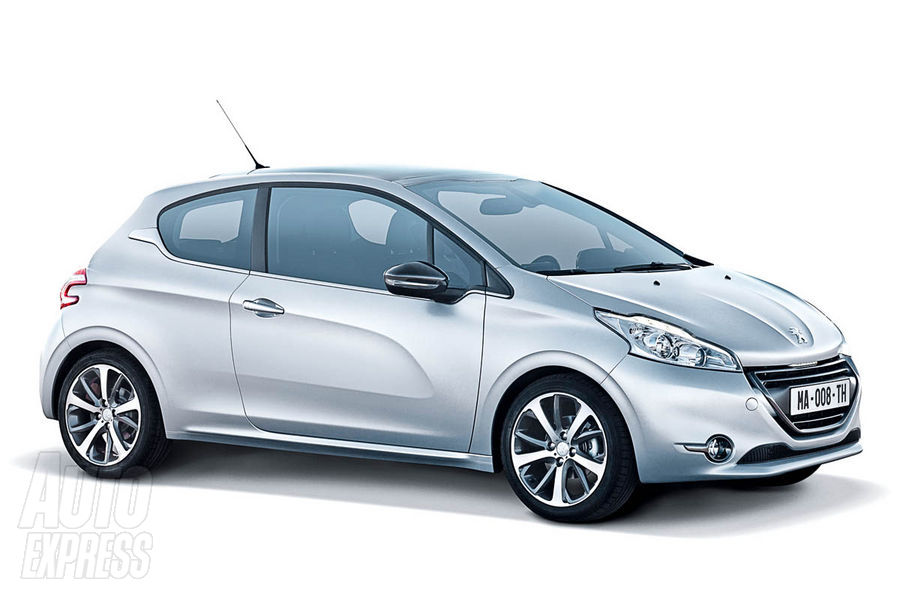
In spite of Peugeot’s rich history in the small car market, the 208 is the company’s most radical reinvention of the supermini ever.
The new car is smaller, lighter, cleaner and more stylish than the 207, bringing improvements in every possible way. And we have the first official pictures and
all the details that matter.
Since the SR1 concept debuted at the 2010 Geneva Motor Show, Peugeot has set about pursuing a new design direction, improving quality and reintroducing the sporty driving experience of old back into its products. And the clean sheet approach to the 208 is the culmination of that process.
Although the three and five-door are based on the same mechanicals, they have been designed from the outset as separate entities. In profile,
the scallop taken from the side of the three-door begins at the tail-lights and curves down along the side of the car.
The five-door uses a less dramatic feature line that runs along the sill and turns upwards behind the front wheel.
Other differences include bars in the three-door’s grille – the five-door gets mesh – and a continuation of the chrome
window trim into the C-pillar, which is a nod to the 205.
Both cars get the floating grille treatment already seen on the 508, as well
as foglamps set flush into the
front bumper and boomerang rear lights complete with
claw-like graphics.
Inside, the revolution continues. A large central touchscreen dominates the
interior on all but the entry-level 208. This controls the
entertainment and navigation functions, plus the vehicle dynamics. Owners wanting to personalise their car can get the screen trimmed in different ‘skins’.
So it’s no surprise that the
layout and materials bear no resemblance to the past, with a glossy finish on the console and soft-touch materials throughout. The steering wheel has shrunk, too, and you view the instrument cluster over the top of it, instead of through it, which Peugeot says helps drivers focus on the road.
It’s not only the steering wheel that’s smaller, either – the whole car is. It’s 7cm shorter and 1cm lower, but the wheelbase is the same as the 207’s. Incredibly, the cabin is more spacious, with 5cm extra legroom, plus the boot is 15 litres bigger, at 285 litres – that’s still 10 litres less than in a Ford Fiesta.
The more compact dimensions mean dramatic weight savings. On average, the 208 is 110kg lighter than the 207, with the base car weighing only 975kg. Plus, the shape, optimised in the wind
tunnel, is more aerodynamic than ever – and fuel economy
will be impressive as a result.
Full engine details have yet to be released, but CO2 emissions have fallen by 34g/km on average compared to the 207. And none of the five diesels, which range from 89bhp to 108bhp, emits more than 99g/km.